The Exclusion We Don’t Always See.
In early years classrooms, exclusion does not always look like conflict or unkindness.
Sometimes, it is much quieter than that.
It lives in the small spaces between children. It happens when play becomes a closed circle, when materials are limited, roles are already taken, the storyline is moving too fast, or the entry point requires skills that not every child has developed yet. Sometimes, the play simply does not connect with a child’s current interests.
And just outside of it, there is a child.
They stand nearby.
They watch.
Sometimes they move a little closer, and sometimes, after a while, they walk away.
It can be easy to think they are choosing to be alone.
But often, that is not what is happening.
Often, they simply cannot find a way in.
Because entering play is not simple. It asks a child to read a situation that is already in motion and somehow step into it. It asks for timing, for shared understanding, for communication, requires specific skills, interests, materials and more.
And sometimes, the play moves faster than they can enter.
A Different Way of Seeing
When we begin to look more closely, something shifts.
Instead of asking why the child is not joining, we begin to wonder if the play itself is accessible.
From a MindClusivity™ perspective, this question changes the role of the educator. It is no longer about guiding the child toward the group. It becomes about gently opening the space.
Not pulling, not prompting, not insisting. but creating the conditions where connection can happen.
Because children do not need to be pushed into belonging. They need to be able to reach it.
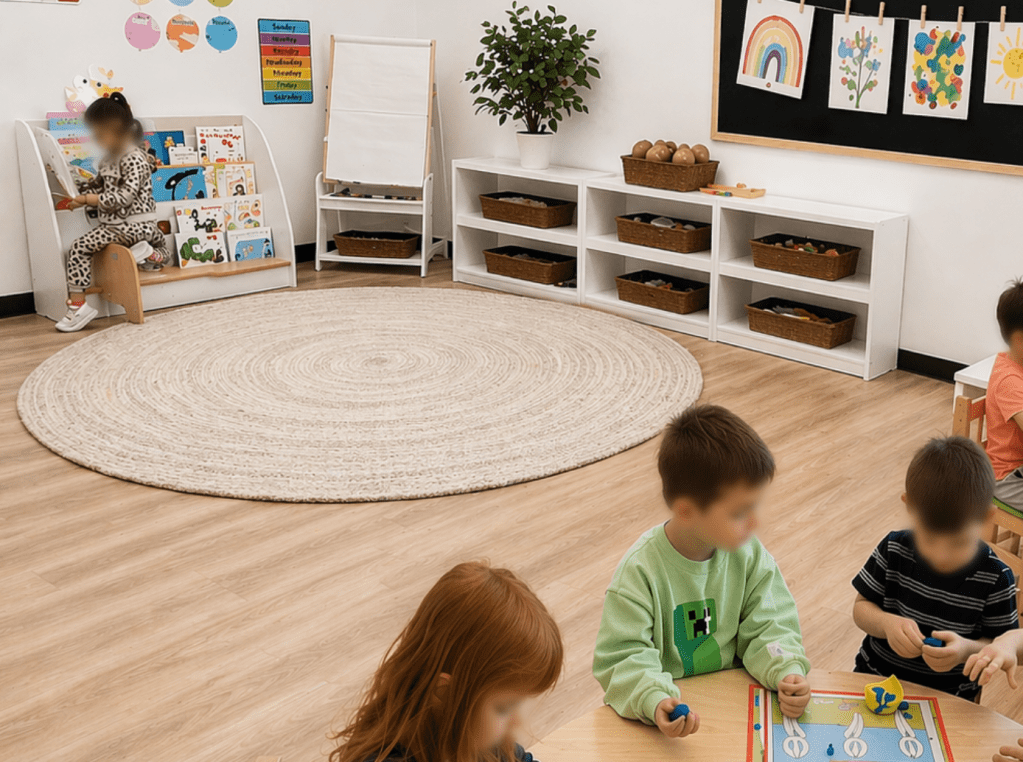
Let’s imagine, a child is near the edge of the room, close enough to see other children, but not joining them. Instead, playing by herself with blocks.
Another child is invited, not to lead, not to teach, but simply to be present, to play with blocks next to her.
Now the room feels different.
The play is no longer far away for her. It exists right next to her. The expectation to “join” disappears.
At first, it is quiet.
Two children, side by side, building separately.
But then, almost without noticing, something begins to overlap.
A hand reaches toward the same pile.
A piece is picked up, then passed.
Their movements start to match.
No one has said “take turns.”
No one has explained what to do.
But something is happening. The play is no longer separate. It is shared.
What began as two individual experiences slowly becomes one. A tower is being built, together. It wobbles, falls, is rebuilt again. There is joint laughter now. A pause. Another attempt.
And in that process, so much is unfolding. Children are negotiating space without words. They are solving problems together. They are staying with something, even when it doesn’t work.
Most importantly, they are connecting.
There comes a moment when the educator is no longer needed. Not because the work is done, but because it has begun.
Stepping back. And the play continues.
Now the experience belongs to the children. It is not something that was created for them, it is something they created together.
Later, the same play appears again. No setup. No invitation. Just children returning to something that felt meaningful.
And this time, more children come. The play grows. It becomes louder, more complex, more alive.
What was once a solitary play moment at the edge of the room becomes something shared, something known.
These moments are easy to overlook.
But they tell us something important. Children are not outside of play because they do not want to belong.
Sometimes, they are simply waiting for a way in.
And when we shift our perspective, when we stop asking children to enter the play and instead bring the play within their reach, we begin to see something different unfold.
Connection that is not forced.
Participation that feels natural.
Belonging that is real.
And often, it begins with something very small.
A few blocks placed nearby. A child sitting beside another. A moment where nothing is required, only possible. And from there, everything else can grow.
 organicplay.ca
Leave a comment