In early childhood settings today, learning is often organized around standardized expectations, predetermined outcomes, and developmental timelines meant to apply to all children equally.
And yet, children do not develop, communicate, engage, or participate in the same ways.
Every child enters learning with different curiosities, motivations, sensory experiences, social approaches, and developmental rhythms.
This is where the importance of tailored education becomes impossible to ignore.
Not education designed around a one-size-fits-all model, but education that begins with the child themselves.
But here is the tension we cannot ignore:
Many learning goals continue to focus primarily on task completion, academic readiness, and observable outcomes.
And yet, the moments where children actually experience connection, communication, confidence, and belonging… are often happening somewhere else entirely.
Where does real social development actually happen?
Often, not during structured table activities or product-driven tasks.
It happens in the moments we tend to overlook:
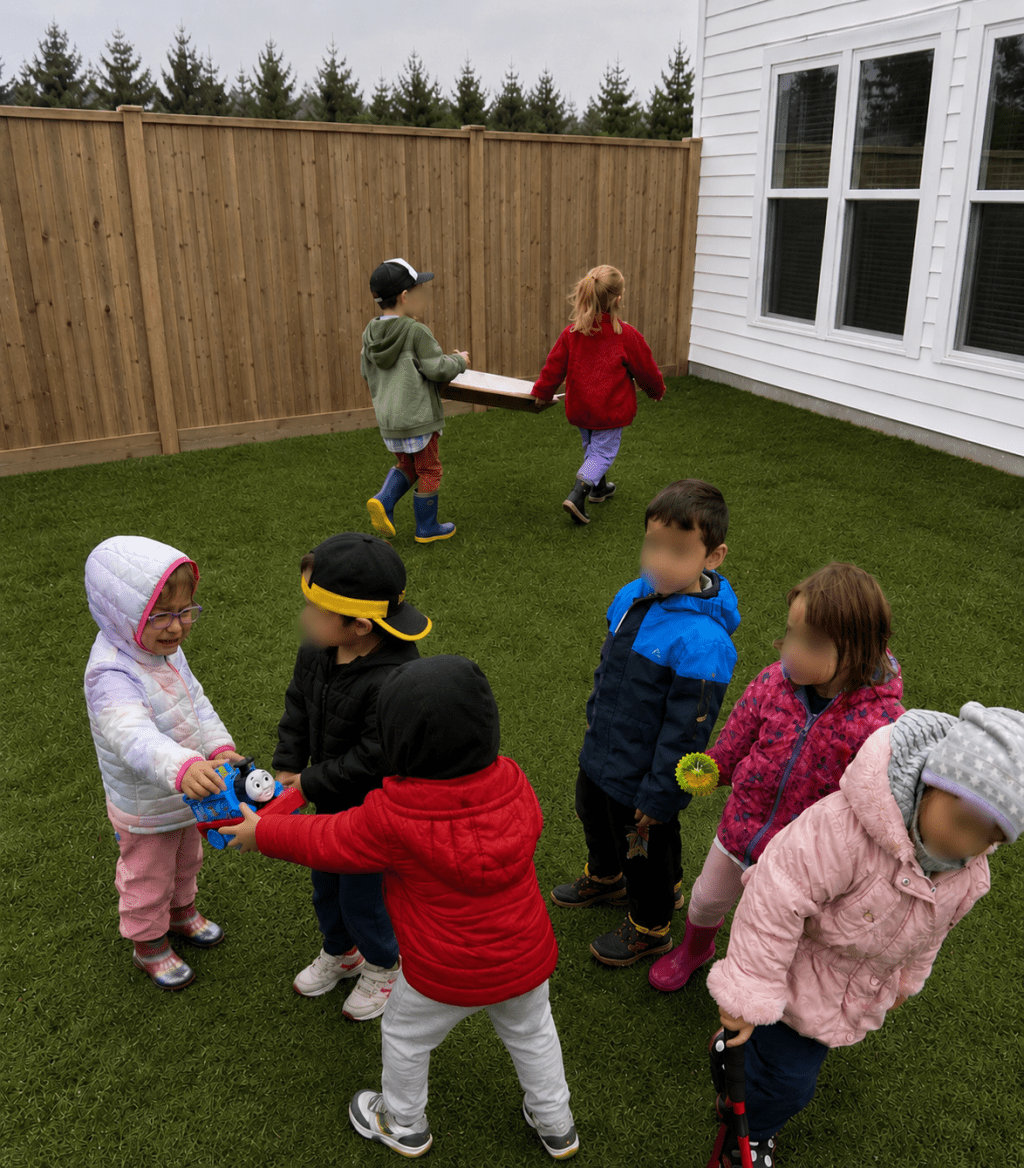
- On the patio
- During recess
- In unstructured play
- In the “in-between” moments of the day
These parts of the day are often treated as breaks from learning.
But for many children, they are where some of the deepest learning takes place.
When children engage in natural, self-directed play, they are not “just playing.” They are learning how to navigate the social world in real time.
They are:
- Negotiating and problem-solving
- Reading social cues and emotions
- Managing frustration and conflict
- Testing ideas and boundaries
- Building confidence, connection, and belonging
There is no script.
No checklist.
No predefined outcome.
Just real, lived interaction.
What we risk when we overlook this ?
When unstructured moments are treated as secondary to “real learning,” we begin; often unintentionally; to separate learning from living.
We focus on what can be measured:
Did the child complete the task?
Did they follow the steps?
Did they produce the expected outcome?
Did they remain seated?
But in doing so, we risk overlooking what matters most:
How the child entered a group?
How they responded to a peer?
How they managed disappointment?
How they communicated an idea?
How they made sense of a shared experience?
How they discovered confidence within interaction?
Did they sustain attention and engagement ?
We begin designing learning around standardized expectations rather than around the child’s actual experience, curiosity, and developmental pathway.
But these are not secondary skills.
They are foundational.
Because the goal is not simply to move children through predefined tasks.
The goal is to create environments where participation becomes meaningful, authentic, and shared.
Tailored education in real moments
If education is truly meant to meet children where they are, then these unstructured, experiential moments should matter even more.
Because this is where learning is:
- Aligned with the child’s curiosity
- Driven by authentic motivation
- Rooted in meaningful interaction
- Responsive to individual developmental rhythms
This is where adult presence becomes powerful; not through control, but through attunement.
In these moments, an adult can:
- Model language naturally in real time
- Create access points into play and participation
- Sustain engagement through connection
- Help interpret social cues as they unfold
- Scaffold flexibility, negotiation, and collaboration
Not as a separate activity. Not as a forced intervention. But as part of the child’s real experience.
And yet, these moments are often supervised for safety, without being fully recognized for their developmental value.
But perhaps this is exactly where tailored education comes most alive.
A shift in value
What if these moments were valued equally; or even more; than performance-based tasks and predetermined outcomes?
What if:
- Recess was seen as a core learning environment
- The patio was understood as a space for social development
- Unstructured play was recognized as essential, not optional
Because in these spaces, children are not performing.
They are becoming.
Not all meaningful learning looks structured. Not all important moments are planned.
Some of the most significant developmental experiences happen in the spaces we label as “breaks.”
And maybe those are the moments where children need us most.
Not to direct. Not to control.
But to be present enough to notice, interpret, and create access when it truly matters.


Leave a Reply